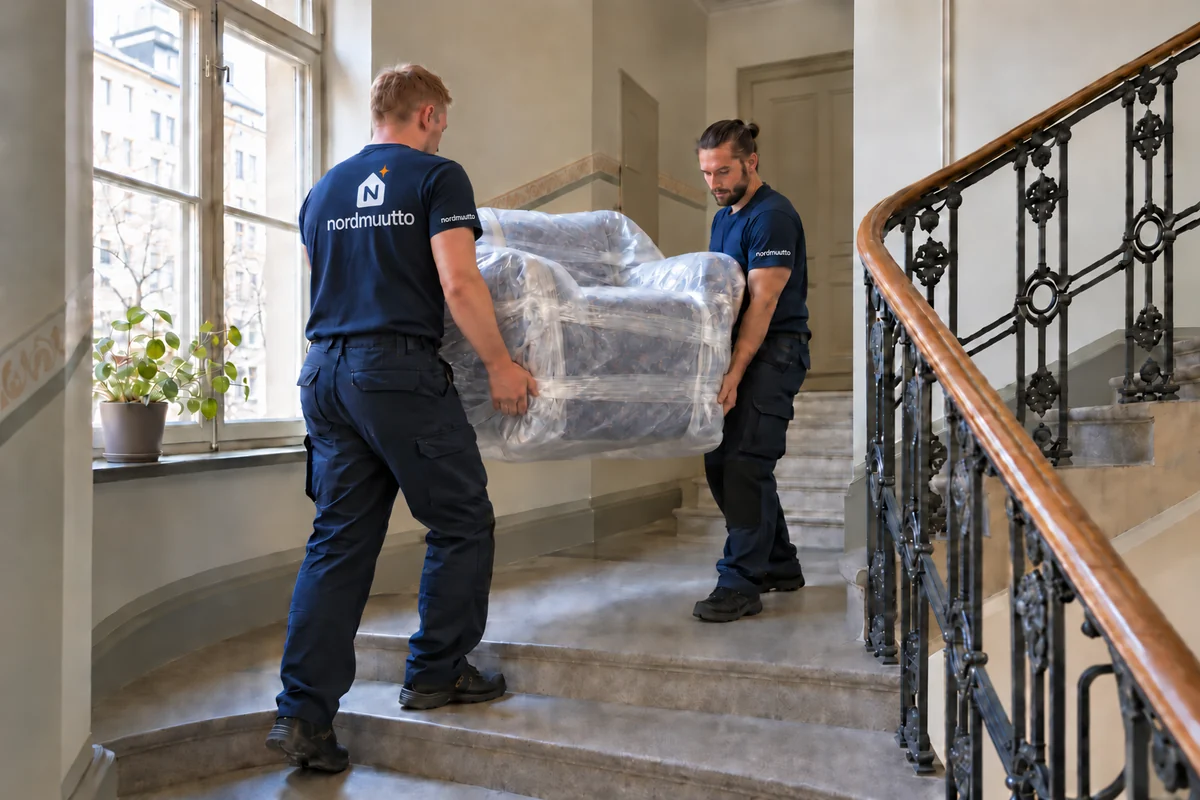
Start with access, not just the apartment size
Moving from an apartment without a lift in Helsinki requires a plan for every large item and every part of the route. A small flat can contain a heavy bed, a long sofa and dozens of boxes. Several flights of stairs multiply the carrying involved, even when the destination is nearby. The most useful starting point is an inventory combined with clear information about the building, rather than a guess based only on square metres.
This guide covers ordinary household moves involving stairs. It helps you prepare useful information for a moving company, organise packing and avoid last-minute surprises. It is not a set of lifting instructions. Awkward furniture, unusually heavy belongings and difficult staircases need an assessment of the actual item and route. Tell the team about these conditions before booking so they can discuss suitable staffing, equipment and any limitations with you.
Describe both buildings accurately
Write down the floor at each address, whether any lift is available and which parts of the route still involve steps. A building described as having a lift may nevertheless have entrance stairs, a narrow lift door or a cabin that cannot take large furniture. Explain these details separately. Include basement storage, attic belongings and any other areas that are part of the move, as they add work beyond the main apartment.
Describe the distance from the vehicle to the stairwell, the entrance door and any narrow corridors. Mention locked gates, entry codes and access times, while sharing sensitive access information directly rather than publishing it. Ask the property contact whether moving arrangements need to be agreed in advance. Check the destination just as carefully as the departure address. A sofa leaving a wide staircase can still encounter a difficult turn at the new home.
Measure furniture and the narrowest parts of the route
Make a list of the largest items with their height, width and depth. Include protruding arms, fixed legs and parts that cannot be removed. Photograph each item from useful angles, then photograph the route: apartment doorway, landing, turns, entrance and any low ceiling. Provide measurements of the tightest openings rather than describing the whole staircase as wide or narrow. Explain any uncertainty so the mover knows what still needs checking.
Comparing one furniture dimension with a doorway width is not enough to prove an item will fit. Turning space, handholds, protective wrapping and the angle of approach all matter. Ask the moving team to assess doubtful items before moving day, potentially through a survey or further photographs. Do not assume that windows, balconies or building fittings can be used as alternative routes. Those arrangements require specific planning, appropriate professionals and any necessary permissions.
Will it fit?
Furniture (cm)
Narrowest opening (cm)
Should fit straight through.
A rough estimate. Measure the narrowest point between the frames and allow for railings and turns.
Decide what can be dismantled before packing
Some beds, tables and shelving units are easier to transport in separate parts. Check the manufacturer's assembly instructions and the condition of the furniture before deciding to dismantle it. A piece that has been moved several times may have worn fittings or fragile panels. Tell the mover about this rather than assuming disassembly and reassembly will always be straightforward. Agree who will do the work and whether it is included in the quote.
Keep screws and fittings in labelled bags attached securely to the relevant item where appropriate. Photograph useful stages and retain the assembly instructions. Avoid mixing hardware from several pieces in one unmarked container. Empty drawers and shelves according to the agreed moving instructions, and make sure loose components are identified. Leave enough time for this preparation before the team arrives. Discovering an assembled wardrobe still full of clothes can change both the work required and the planned sequence.
Reduce the load before moving day
Walk through the flat and separate belongings into those you will move, those you can pass on and those requiring disposal. Start this early enough to complete collections before the booked move. A cupboard marked for donation is still part of the workload if it remains in the apartment when the crew arrives. Do not assume that a standard moving booking includes disposal, donation deliveries or additional stops.
HSY's furniture guidance points to reuse options and services for large unwanted items. Check the current arrangements for the item you have, including acceptance conditions and any charges. Arrange an appropriate collection or drop-off rather than leaving furniture in a communal waste area. Once the remaining inventory is settled, update the moving company if the volume has changed significantly. Removing unnecessary items can simplify the move, but an accurate final list is still needed for planning the vehicle and crew.
Pack boxes for repeated carrying
Choose boxes that are sound and easy to close. Put dense contents such as books into smaller containers and spread weight sensibly. Avoid boxes with damaged handles, loose bottoms or contents sticking out. Label the destination room and identify fragile contents, but do not rely on a fragile label to compensate for inadequate packing. Wrap individual breakable items and use suitable cushioning so they cannot move freely inside the box.
Group boxes by destination while keeping the apartment's walking routes clear. Leave sufficient room around large furniture for the agreed preparation work. Pack a separate essentials bag with documents, keys, chargers and overnight necessities. If you are moving with friends as well as professional movers, agree who is responsible for which items. Unplanned movement in opposite directions on a narrow staircase makes coordination harder and can interrupt the team's carrying sequence.
Protect shared spaces without blocking them
Ask the building contact about suitable protection for floors, corners and other vulnerable surfaces. Agree what the moving team will provide and which preparations belong to you. Use protection appropriate to the surface, and avoid adhesive products that could damage finishes. Any covering on a walking route must stay secure. The aim is to protect the building while preserving a clear, usable passage for movers and other residents.
Do not use landings, stairs or emergency routes as temporary storage areas. Keep doors and access points managed in accordance with building rules, rather than improvising ways to hold them open. If neighbours need advance notice of activity, send a brief practical message through the normal building channel. State the planned time and a contact person without promising exclusive use of shared areas. Check the route again after the move and report any concern promptly through the agreed contact.
Arrange legal loading access near the entrance
The staircase is only one part of the carry. A long outdoor route between the vehicle and the building can add substantial work. Describe the available loading position, street restrictions and any courtyard access rules when asking for a quote. Consult the property's instructions and Helsinki's parking guidance if the arrangement is unclear. Do not assume a moving vehicle may occupy any convenient space beside the entrance.
If the nearest suitable position is some distance away, give an honest estimate of that distance and mention steps or slopes along the way. In winter, check snow and gritting arrangements as well. Keep an alternative plan for a loading position becoming unavailable, and tell the mover about it in advance. Clear access information helps the company plan the whole route, rather than discovering after arrival that the advertised third-floor move also includes a long courtyard carry.
Understand how stairs influence the quote
A moving quote should reflect the belongings, the route and the services requested. Floors without a lift, difficult turns, long carrying distances and furniture preparation may all affect the work. The number of movers and the equipment should follow the actual assessment. There is no reliable universal price per floor that can describe every household move, so compare the scope and pricing basis rather than a headline number alone.
Ask whether the quote is based on a fixed scope or time worked, what assumptions it uses and which additional charges may apply. Confirm the consumer price and payment terms before booking. If you add belongings or discover an access restriction, tell the company promptly. Accurate information helps prevent avoidable changes. A cheap-looking quote based on incomplete details is less useful than a clear proposal that describes the work your apartment actually requires.
Use an illustrative planning example
Imagine a two-room apartment on the third floor without a lift. The household has a sofa, a bed that can be dismantled, a dining table and packed boxes. The destination has a lift, but the sofa will not fit in it. For planning purposes, both staircases therefore matter. The customer sends furniture dimensions, photographs of the turns and information about where the vehicle can load at each address.
This is an example, not a completed Nordmuutto customer job or a price promise. Its lesson is that the destination's lift does not automatically remove all stair carrying. A good request distinguishes between items that can use the lift and those that need another agreed route. It also explains who dismantles the bed, where the parts should go and whether any storage-room contents remain. Those details make the proposed scope much easier to understand and compare.
Prepare the final walkthrough and request your quote
Before the team starts, walk through the apartment together and identify fragile, unusual and excluded items. Confirm the destination rooms and the contact person at the new address. Point out any change since the quote was prepared, including building works, access problems or extra furniture. If a route appears unsafe or an item does not fit as expected, pause for an agreed solution rather than trying to force the original plan.
For a Nordmuutto quote, include the date, both areas or addresses, floors, lift details, approximate volume and large furniture dimensions. Mention packing assistance or disassembly if needed. Call or use the quote form to discuss the move, then agree the scope and price before confirming a booking. After unloading, check that large items are in their intended rooms and that shared routes are clear. Keep the packing and moving-cost guides below handy for the remaining preparation.
Useful official guidance
HSY: furniture reuse and recyclingHelsinki: parking guidanceHelp with your move
Explore the service and tell us about your move. We agree the scope and price before confirming a booking.
Home movesGet a free moving quote